Head-to-Head Aerospace Analysis
Falcon 9 vs. Starship
The Commercial Workhorse vs. Next-Generation Fully Reusable Megastructure
Falcon 9 and Starship represent two distinct evolutionary epochs in aerospace engineering from SpaceX. Falcon 9 perfected first-stage vertical propulsive landing and partial reusability, driving global launch costs down and capturing over 80% of annual orbital mass deployed worldwide. Starship builds upon that heritage to introduce 100% full-stack reusability, a 9-meter stainless-steel airframe, and full-flow staged combustion methalox propulsion designed to lift over 100 metric tons into Low Earth Orbit at a fraction of expendable costs.
Key Architectural Takeaways
01
Falcon 9 is partially reusable (booster and fairing recovered; second stage expended), whereas Starship is engineered for 100% full-stack reusability across Super Heavy booster and Starship upper stage.
02
Starship delivers over 4.5x the payload mass to Low Earth Orbit (100–150t reusable vs. 22.8t expendable / ~17.5t drone ship recovery for Falcon 9).
03
Falcon 9 uses Kerolox (RP-1 / LOX) with open gas-generator Merlin 1D engines; Starship uses Methalox (liquid methane / LOX) with closed full-flow staged combustion Raptor engines.
04
Starship's orbital refilling architecture enables deep-space missions, crewed lunar Artemis landings, and Mars transit flights beyond Falcon 9's structural capacity.
CAD Scale & Performance Blueprint
Falcon 9 vs Starship — Structural & Payload Envelope
Falcon 9Starship
Technical Specification Matrix
Direct engineering comparison across structural mass, payload capacity, propulsion, and pricing.
| Specification Matrix | 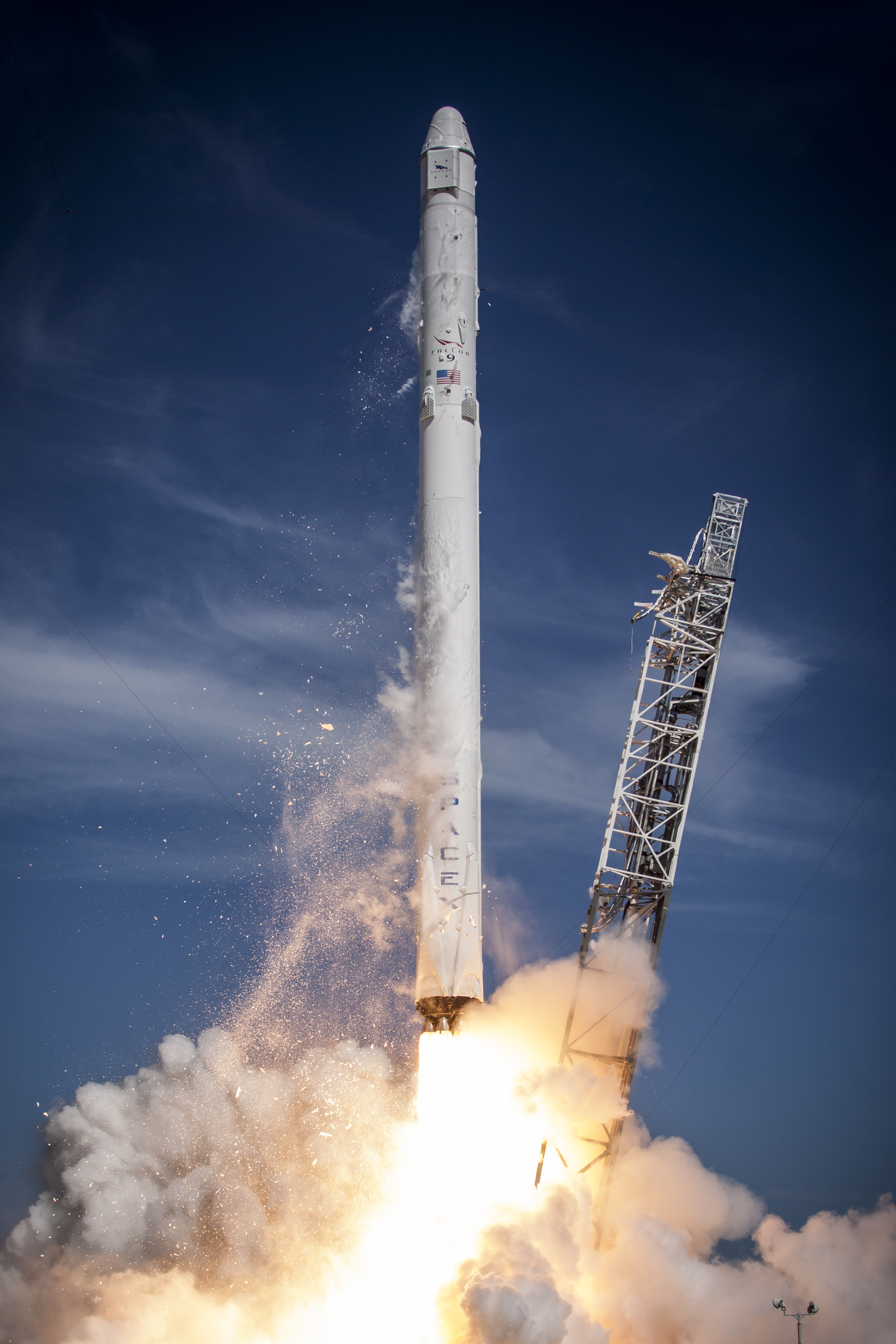 |  |
|---|---|---|
| Status | Operational | Development |
| Height (m) | 70 | 121.3 |
| Diameter (m) | 3.7 | 9 |
| Mass (kg) | 549,054 | 5,000,000 |
| Stages | 2 | 2 |
| Propellant | Densified LOX / Rocket Grade Kerosene (RP-1) | Subcooled LOX / Liquid Methane (CH4) |
| Payload to LEO (kg) | 22,800 | 150,000★ Best |
| Payload to GTO (kg) | 8,300 | 63,000★ Best |
| Fairing Diameter (m) | 5.2 | 9★ Best |
| Reusable (first stage) | Yes | Yes |
| Reusable (fairing) | Yes | Yes |
| Launch Cost (USD) | $67,000,000★ Best | $100,000,000 |
| Cost per kg to LEO | $2,939 | $667★ Best |
| Success Rate (%) | 99.5%★ Best | 66.7% |
| First Launch | 2010-06-04 | 2023-04-20 |
| Launch Sites | Cape Canaveral Space Force Station Space Launch Complex 40 (SLC-40), Kennedy Space Center Launch Complex 39A (LC-39A), Vandenberg Space Force Base Space Launch Complex 4E (SLC-4E) | Starbase Orbital Launch Complex Orbital Pad A / Pad B, Kennedy Space Center Launch Complex 39A (LC-39A Starship Mount) |
1. Payload Capacity Across Orbital Regimes (LEO, GTO, TLI)
Falcon 9 is optimized for Low Earth Orbit (LEO) mega-constellation deployment (Starlink) and Geostationary Transfer Orbit (GTO) commercial communications satellites. In its standard ASDS drone ship recovery configuration, Falcon 9 reliably injects 17,500 kg into LEO or 5,500 kg into GTO. In contrast, Starship's massive internal cargo hold (9 meters in diameter with over 1,000 cubic meters of usable volume) can deploy 100 to 150 metric tons directly to LEO without expending any flight hardware. While Falcon 9 requires a dedicated expendable upper stage to deliver payloads to high-energy translunar injection (TLI) orbits, Starship leverages orbital refilling in LEO to send 100+ metric tons of payload to lunar or interplanetary trajectories.
2. Propulsion Architecture, Propellants & Specific Impulse (Isp)
The propulsion gap between both vehicles illustrates 15 years of liquid rocket engine advancement. Falcon 9 is powered by 9 Merlin 1D engines on the first stage and a single vacuum-optimized MVac on the upper stage, operating on the open gas-generator cycle with RP-1 kerosene and liquid oxygen. Merlin 1D delivers an exceptional thrust-to-weight ratio (>180) and 311 seconds of vacuum specific impulse (Isp). Starship is powered by 33 Raptor engines on the Super Heavy booster and 6 Raptor engines (3 sea-level, 3 vacuum) on the upper stage. Raptor operates on the full-flow staged combustion cycle with liquid methane and liquid oxygen (Methalox). Raptor operates at extreme chamber pressures exceeding 250 to 300 bar, achieving 380 seconds of vacuum specific impulse and producing over 74,000 kN of liftoff thrust—more than double the Saturn V.
3. Launch Economics, Pricing & Cost-Per-Kilogram
Falcon 9 transformed commercial launch economics by reducing the list price of dedicated medium-heavy launches to approximately $67M, corresponding to ~$3,800/kg to LEO (or ~$2,900/kg in expendable mode). SpaceX's internal marginal launch cost for a flight-proven Falcon 9 is estimated between $15M and $28M, with the expendable second stage and refurbishment operations making up the bulk of remaining marginal costs. Starship seeks to collapse this cost floor entirely: by eliminating the discarded upper stage and recovering both Super Heavy and Starship via tower catching arms ('Mechazilla'), the marginal cost per launch is projected to drop below $20M per flight, bringing price-per-kilogram to Low Earth Orbit below $200/kg.
4. Reusability Dynamics & Recovery Operational Profiles
Falcon 9 relies on a proven recovery cycle: the first-stage booster performs an exo-atmospheric boostback burn, supersonic entry burn, and transonic landing burn onto an Autonomous Spaceport Drone Ship (ASDS) or Return To Launch Site (RTLS) concrete pad, deploying titanium grid fins and deployable carbon-composite landing legs. The second stage is intentionally deorbited into the South Pacific after payload deployment. Starship radically alters this approach: the Super Heavy booster decelerates to a hovering zero-velocity touchdown directly into catching arms mounted on the launch integration tower, eliminating landing legs and landing propellant weight penalties. Starship's upper stage re-enters Earth's atmosphere belly-first protected by hexagonal ceramic heat shield tiles, executing a dynamic 'belly-flop' skydiver maneuver before performing a flip-and-catch landing at the tower.
5. Operational Flight Heritage & Mission Manifests
Falcon 9 is the most successful and reliable rocket in human spaceflight history, having completed over 350 successful flights with an operational cadence exceeding 100 launches per year and boosters demonstrated to fly more than 20 times. It is NASA's primary vehicle for crewed astronaut missions to the International Space Station (Commercial Crew Program). Starship is currently advancing through rigorous integrated flight testing (IFT) from Starbase in Boca Chica, Texas, demonstrating Super Heavy tower catches, starship atmospheric entry survival, and payload bay door operation as it prepares to execute the NASA Artemis III and IV Human Landing System (HLS) missions.
ENGINEERING CONCLUSION // VERDICT
Analytical Comparison Summary
Falcon 9 remains the undisputed commercial benchmark for operational reliability, satellite constellation deployment, and orbital rideshare missions today. Starship represents the imminent generational shift toward super-heavy, fully reusable orbital transport that will render expendable upper stages obsolete for large-scale space infrastructure.
Other Popular Launch Vehicle Comparisons
Starship vs. Falcon Heavy
Next-Gen Monolithic Starship vs. Multi-Core Kerolox Heavy Lifter
Read comparison
Falcon 9 vs. Electron
Commercial Rideshare Heavyweight vs. Dedicated Smallsat Precision Launcher
Read comparison
Ariane 6 vs. Vulcan Centaur
Europe's Sovereign Heavy Launcher vs. America's National Security Workhorse
Read comparison
New Glenn vs. Starship
The Battle of the Commercial Methalox Giants
Read comparison
Starship vs. Space Launch System (SLS)
Commercial Agile Reusability vs. Institutional Deep-Space Power
Read comparison
Falcon 9 vs. New Glenn
The Proven Commercial Workhorse vs. Heavy-Lift Challenger
Read comparison
Atlas V vs. Vulcan Centaur
The Legendary Mission-Assurance Veteran vs. The Modernized Methane Successor
Read comparison