Head-to-Head Aerospace Analysis
Falcon 9 vs. New Glenn
The Proven Commercial Workhorse vs. Heavy-Lift Challenger
Falcon 9 is the commercial space industry's proven flight benchmark, holding an undisputed record for flight frequency and first-stage booster reusability. Blue Origin's New Glenn is designed to scale past Falcon 9's medium-heavy capacity into true heavy-lift territory, featuring a 7-meter diameter booster, massive payload fairing, and high-energy Hydrolox upper stage intended to capture major commercial and national security market share.
Key Architectural Takeaways
01
New Glenn is a 7-meter diameter heavy-lift rocket (45,000 kg LEO); Falcon 9 is a 3.7-meter medium-heavy vehicle (22,800 kg LEO expendable / ~17,500 kg reusable).
02
Both rockets feature reusable first stages landing on maritime drone ships downrange.
03
Falcon 9 uses 9 Merlin 1D Kerolox engines; New Glenn uses 7 BE-4 Methalox staged-combustion engines.
04
Falcon 9 launches over 100 times annually with rapid booster turnaround; New Glenn is entering flight operations to provide vital non-SpaceX commercial competition.
CAD Scale & Performance Blueprint
Falcon 9 vs New Glenn — Structural & Payload Envelope
Falcon 9New Glenn
Technical Specification Matrix
Direct engineering comparison across structural mass, payload capacity, propulsion, and pricing.
| Specification Matrix | 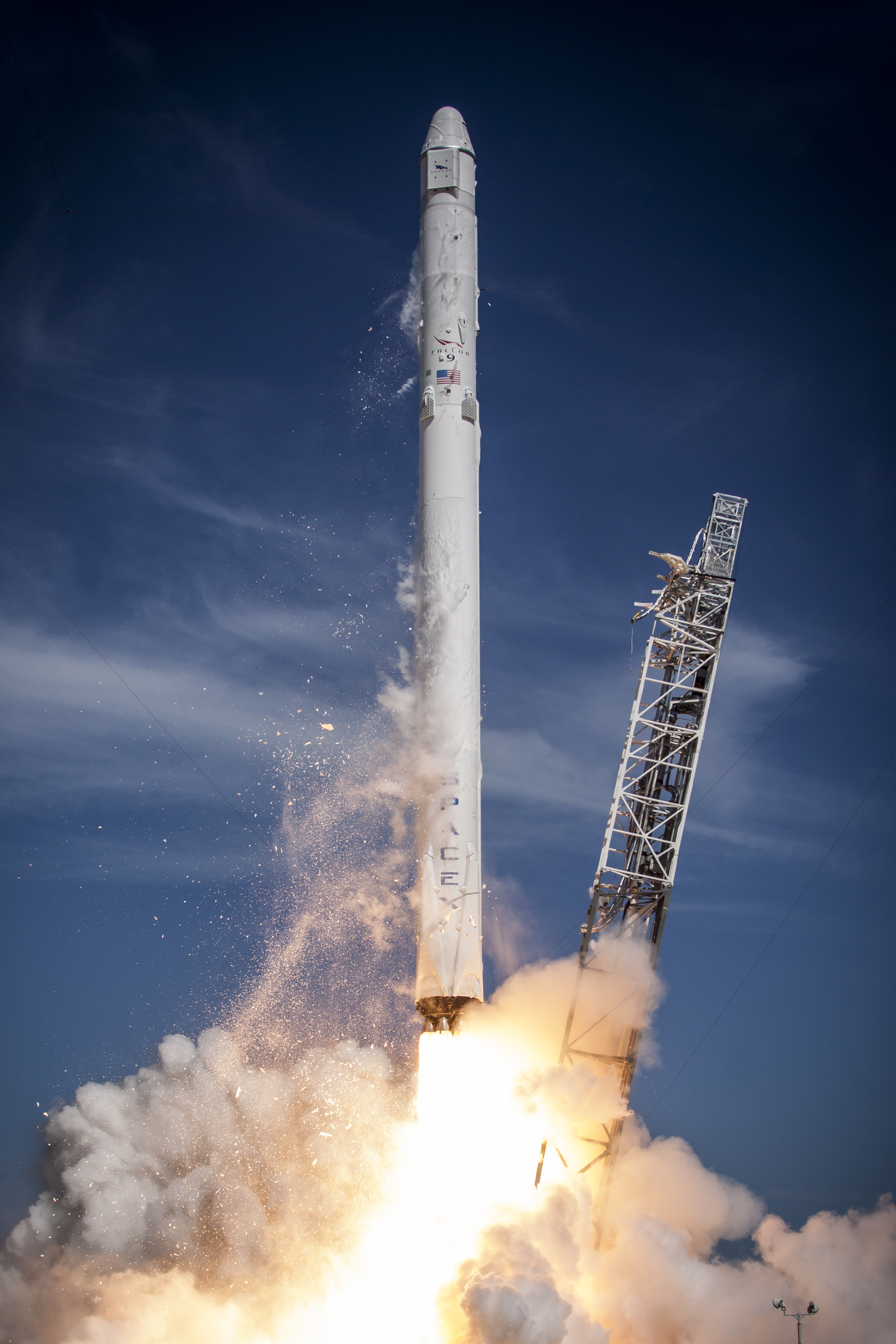 |  BO |
|---|---|---|
| Status | Operational | Development |
| Height (m) | 70 | 98 |
| Diameter (m) | 3.7 | 7 |
| Mass (kg) | 549,054 | 1,500,000 |
| Stages | 2 | 2 |
| Propellant | Densified LOX / Rocket Grade Kerosene (RP-1) | LOX / Liquefied Natural Gas (Methane) |
| Payload to LEO (kg) | 22,800 | 45,000★ Best |
| Payload to GTO (kg) | 8,300 | 13,600★ Best |
| Fairing Diameter (m) | 5.2 | 7★ Best |
| Reusable (first stage) | Yes | Yes |
| Reusable (fairing) | Yes | Yes |
| Launch Cost (USD) | $67,000,000★ Best | $68,000,000 |
| Cost per kg to LEO | $2,939 | $1,511★ Best |
| Success Rate (%) | 99.5% | 100%★ Best |
| First Launch | 2010-06-04 | 2025-01-16 |
| Launch Sites | Cape Canaveral Space Force Station Space Launch Complex 40 (SLC-40), Kennedy Space Center Launch Complex 39A (LC-39A), Vandenberg Space Force Base Space Launch Complex 4E (SLC-4E) | Cape Canaveral Space Force Station Launch Complex 36 (LC-36) |
1. Payload Capacity Across Orbital Regimes (LEO, GTO, TLI)
New Glenn provides more than double Falcon 9's payload mass to Low Earth Orbit (45,000 kg reusable vs. 17,500 kg drone ship recovery). In addition, New Glenn's 7-meter fairing accommodates large dual-manifest commercial payloads and high-volume satellite constellations that would exceed Falcon 9's 5.2-meter fairing envelope. For Geostationary Transfer Orbit (GTO), New Glenn delivers up to 13,600 kg with an expendable upper stage, compared to Falcon 9's 5,500 kg in reusable recovery mode.
2. Propulsion Architecture, Propellants & Specific Impulse (Isp)
Falcon 9 relies on 9 Merlin 1D gas-generator engines burning RP-1 and LOX, producing 7,607 kN of liftoff thrust. New Glenn uses 7 BE-4 staged combustion engines burning liquid methane and LOX, producing ~17,000 kN of thrust. Liquid methane produces zero soot and minimal coking, reducing post-flight engine cleaning requirements and enabling faster re-flight cycles compared to kerosene.
3. Launch Economics, Pricing & Cost-Per-Kilogram
Falcon 9 has established the commercial price baseline for global satellite launch at ~$67M per flight. New Glenn targets heavy-lift commercial payloads at competitive price points, leveraging major enterprise manifests like Amazon Project Kuiper to scale production volume and amortize fixed launch infrastructure at Space Launch Complex 36.
4. Reusability Dynamics & Recovery Operational Profiles
Both vehicles adopt the downrange drone ship recovery profile for their boosters. Falcon 9 boosters land on automated spaceport drone ships stationed 600–800 km downrange in the Atlantic or Pacific. New Glenn lands its 7-meter booster on the ocean landing platform 'Jacklyn', which is designed to operate in higher sea states with automated landing stabilization.
5. Operational Flight Heritage & Mission Manifests
Falcon 9 has completed over 350 successful flights with an unprecedented safety record and human-rating for NASA astronauts. New Glenn is making its flight debut, supported by extensive development of the BE-4 engine already flight-proven on ULA's Vulcan Centaur.
ENGINEERING CONCLUSION // VERDICT
Analytical Comparison Summary
Falcon 9 is the reliable commercial incumbent for medium-mass payloads and rapid constellation replenishment. New Glenn enters the market as a high-capacity heavy lifter capable of lofting larger single-manifest payloads and deep-space missions.
Other Popular Launch Vehicle Comparisons
Falcon 9 vs. Starship
The Commercial Workhorse vs. Next-Generation Fully Reusable Megastructure
Read comparison
Starship vs. Falcon Heavy
Next-Gen Monolithic Starship vs. Multi-Core Kerolox Heavy Lifter
Read comparison
Falcon 9 vs. Electron
Commercial Rideshare Heavyweight vs. Dedicated Smallsat Precision Launcher
Read comparison
Ariane 6 vs. Vulcan Centaur
Europe's Sovereign Heavy Launcher vs. America's National Security Workhorse
Read comparison
New Glenn vs. Starship
The Battle of the Commercial Methalox Giants
Read comparison
Starship vs. Space Launch System (SLS)
Commercial Agile Reusability vs. Institutional Deep-Space Power
Read comparison
Atlas V vs. Vulcan Centaur
The Legendary Mission-Assurance Veteran vs. The Modernized Methane Successor
Read comparison