Head-to-Head Aerospace Analysis
Starship vs. Space Launch System (SLS)
Commercial Agile Reusability vs. Institutional Deep-Space Power
Starship and the Space Launch System (SLS) are the two pillars of NASA's Artemis campaign to return humans to the Moon. SLS is a NASA-designed, government-contracted expendable super-heavy launcher derived from Space Shuttle flight hardware, engineered to launch the Orion crew capsule directly into translunar injection. Starship is SpaceX's commercially developed, fully reusable architecture contracted by NASA to serve as the Artemis Human Landing System (HLS) that ferries astronauts from lunar orbit down to the Moon's South Pole.
Key Architectural Takeaways
01
SLS is fully expendable (every launch discards 4 RS-25 engines, core stage, and solid boosters); Starship is designed for complete two-stage reusability.
02
SLS Block 1 lifts 27,000 kg to TLI and 95,000 kg to LEO; Starship delivers 100,000–150,000 kg to LEO and 100,000+ kg to the Moon with orbital refueling.
03
An SLS launch costs an estimated $2.2B+ per mission; Starship targets commercial launch costs under $30M–$50M.
04
SLS delivers human crews on Orion directly to lunar orbit on a single launch; Starship requires multiple cryogenic tanker refilling flights in LEO prior to lunar transit.
CAD Scale & Performance Blueprint
Starship vs Space Launch System — Structural & Payload Envelope
StarshipSpace Launch System
Technical Specification Matrix
Direct engineering comparison across structural mass, payload capacity, propulsion, and pricing.
| Specification Matrix |  | 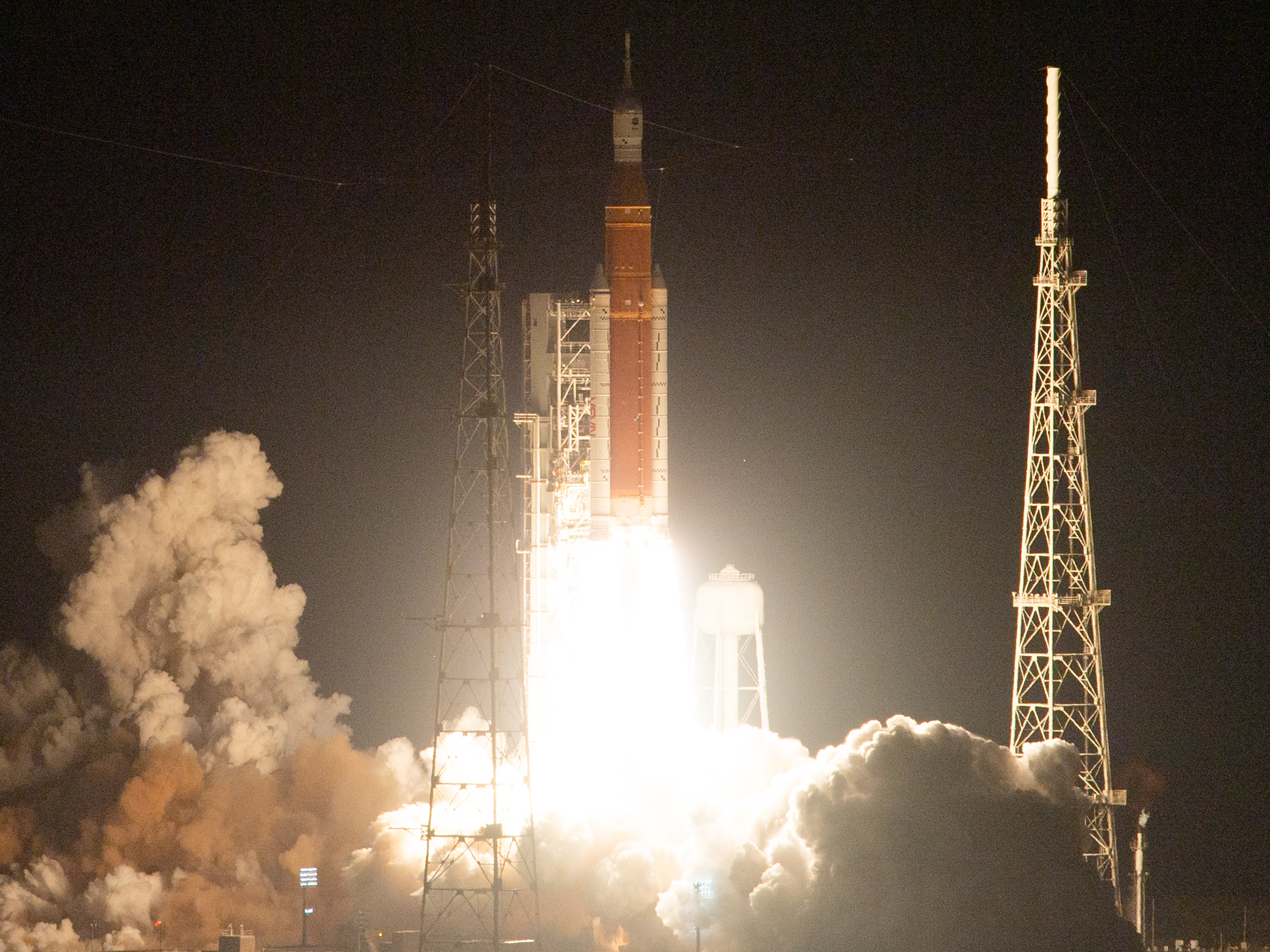 NASA |
|---|---|---|
| Status | Development | Operational |
| Height (m) | 121.3 | 98.2 |
| Diameter (m) | 9 | 8.4 |
| Mass (kg) | 5,000,000 | 2,600,000 |
| Stages | 2 | 2 |
| Propellant | Subcooled LOX / Liquid Methane (CH4) | Liquid Oxygen (LOX) / Liquid Hydrogen (LH2) |
| Payload to LEO (kg) | 150,000★ Best | 95,000 |
| Payload to GTO (kg) | 63,000★ Best | 0 |
| Fairing Diameter (m) | 9★ Best | 8.4 |
| Reusable (first stage) | Yes | No |
| Reusable (fairing) | Yes | No |
| Launch Cost (USD) | $100,000,000★ Best | $2,000,000,000 |
| Cost per kg to LEO | $667★ Best | $21,052 |
| Success Rate (%) | 66.7% | 100%★ Best |
| First Launch | 2023-04-20 | 2022-11-16 |
| Launch Sites | Starbase Orbital Launch Complex Orbital Pad A / Pad B, Kennedy Space Center Launch Complex 39A (LC-39A Starship Mount) | Kennedy Space Center Launch Complex 39B (LC-39B) |
1. Payload Capacity Across Orbital Regimes (LEO, GTO, TLI)
SLS Block 1 generates 39,000 kN of liftoff thrust using two 5-segment solid rocket boosters and 4 RS-25 Hydrolox core engines, delivering the 26,000 kg Orion spacecraft directly into a translunar injection (TLI) orbit in a single launch. Starship cannot reach the Moon with a heavy payload in a single launch because its upper stage is massive (~100t dry mass) and utilizes Methalox. However, once refilled in LEO by multiple Starship tanker flights, Starship can deliver an astonishing 100+ metric tons of usable payload and pressurized habitat directly to the lunar surface—more than five times the mass of the entire Apollo Lunar Module.
2. Propulsion Architecture, Propellants & Specific Impulse (Isp)
SLS features flight-proven Space Shuttle heritage: four Aerojet Rocketdyne RS-25 (SSME) engines operating on the staged combustion cycle burning liquid hydrogen and liquid oxygen with a vacuum Isp of 452 seconds, paired with two 5-segment solid rocket boosters providing 75% of initial liftoff thrust. Starship uses 33 Raptor 2/3 engines on Super Heavy and 6 on Starship, all burning liquid methane and LOX on the full-flow staged combustion cycle. While RS-25 delivers higher specific impulse, Raptor provides vastly superior thrust density, throttle control, and rapid reusability without expensive overhauls.
3. Launch Economics, Pricing & Cost-Per-Kilogram
The economic disparity between both systems is one of the most widely debated topics in aerospace policy. According to NASA's Office of Inspector General (OIG), an SLS launch costs approximately $2.2 billion per mission (or over $4.1 billion when including the Orion capsule and ground systems). Because every SLS flight discards four flight-heritage RS-25 engines and custom-built core stages, its marginal costs cannot decrease significantly. Starship is privately developed by SpaceX at a fraction of the budget, with target marginal launch costs below $20M–$50M.
4. Reusability Dynamics & Recovery Operational Profiles
SLS is 100% expendable. The solid rocket boosters splash into the Atlantic Ocean without recovery, the core stage burns up in the atmosphere over the Pacific, and the Interim Cryogenic Propulsion Stage (ICPS) is expended after lunar injection. Starship is 100% reusable, catching both the booster and upper stage at launch integration towers.
5. Operational Flight Heritage & Mission Manifests
SLS achieved a flawless maiden flight on Artemis I in November 2022, sending an uncrewed Orion capsule on a 25-day lunar circumlunar mission. It is certified for crewed flight on Artemis II. Starship has logged multiple integrated flight tests, demonstrating Super Heavy catches and orbital velocity entries as it works toward Artemis III.
ENGINEERING CONCLUSION // VERDICT
Analytical Comparison Summary
SLS and Starship are complementary rather than mutually exclusive in NASA's current lunar architecture: SLS launches astronauts safely on Orion to lunar orbit, where they dock with Starship HLS to land on the lunar surface.
Other Popular Launch Vehicle Comparisons
Falcon 9 vs. Starship
The Commercial Workhorse vs. Next-Generation Fully Reusable Megastructure
Read comparison
Starship vs. Falcon Heavy
Next-Gen Monolithic Starship vs. Multi-Core Kerolox Heavy Lifter
Read comparison
Falcon 9 vs. Electron
Commercial Rideshare Heavyweight vs. Dedicated Smallsat Precision Launcher
Read comparison
Ariane 6 vs. Vulcan Centaur
Europe's Sovereign Heavy Launcher vs. America's National Security Workhorse
Read comparison
New Glenn vs. Starship
The Battle of the Commercial Methalox Giants
Read comparison
Falcon 9 vs. New Glenn
The Proven Commercial Workhorse vs. Heavy-Lift Challenger
Read comparison
Atlas V vs. Vulcan Centaur
The Legendary Mission-Assurance Veteran vs. The Modernized Methane Successor
Read comparison