Falcon 9
The world's first orbital-class reusable rocket, leading global commercial and crewed spaceflight.
Falcon 9 is a two-stage, reusable launch vehicle designed and manufactured by SpaceX for the reliable and safe transport of people and payloads into Earth orbit and beyond. As the first orbital class rocket capable of reflight, Falcon 9 has revolutionized the economics of space access through rapid booster turnaround and vertical propulsive landing on drone ships and landing zones.
SpaceStats Reliability & Flight Record
Architecture Analysis & Development Story
Engineering DossierHistory & Development
Conceived in the late 2000s as a successor to Falcon 1, Falcon 9 made its maiden voyage on June 4, 2010. Over its operational lifetime, the vehicle underwent aggressive engineering evolution from v1.0 through v1.1, Full Thrust, and culminated in the definitive Block 5 architecture in 2018. Block 5 incorporated titanium grid fins, upgraded thermal protection systems (including a carbon fiber interstage and bolted engine heat shields), higher thrust Merlin 1D engines, and reinforced octaweb structures designed to fly up to 20 or more missions per booster with minimal refurbishments.
Operational Record & Mission Impact
Falcon 9 has set unprecedented records in modern aerospace, completing hundreds of consecutive successful orbital flights. It serves as NASA's primary crew transportation system to the International Space Station via the Crew Dragon spacecraft, regularly deploys the global Starlink megaconstellation, and launches commercial geostationary communications satellites and deep-space scientific observatories.
Key Engineering Innovations & Design Highlights
Nine sea-level Merlin 1D engines arranged in an Octaweb configuration with active differential throttling and gimballing.
Autonomous hypersonic grid fins and cold-gas thruster reaction control systems for unpowered atmospheric entry orientation.
Deployable carbon-fiber landing legs with internal crush cores for shock absorption upon touchdown.
Sub-cooled cryogenic densified propellants (Liquid Oxygen at -207°C and chilled RP-1) maximizing tankage energy density.
Technical & Propulsion Specifications
Operator: SpaceXVehicle Dimensions & Mass
- Overall Height
- 70 m
- Body Diameter
- 3.7 m
- Gross Lift-off Mass
- 549.1 t
- Stages Count
- 2
- Fairing Diameter
- 5.2 m
First Stage Booster (Block 5)
- Main Engines
- 9x Merlin 1D (M1D)
- Propellant
- Densified LOX / Rocket Grade Kerosene (RP-1)
- SL Thrust
- 7,607 kN
- Vacuum Isp
- 311s
- Dry Mass
- 25.6 t
- Recovery Mode
- ASDS_DroneShip
Second Stage (Upper Stage)
- Upper Engine
- 1x Merlin 1D Vacuum (MVacD)
- LEO Capacity
- 22.8 t
- GTO Capacity
- 8.3 t
- TLI (Lunar)
- 4 t
- Cost per Launch
- $67,000,000
- LEO Price / kg
- ~$2,939 / kg
Launch Complexes & Spaceports Network
3 Active Launch PadsMilestone & Historic Missions
Key Flight AchievementsORBCOMM OG2-M2
Customer: ORBCOMM
First successful vertical propulsive landing of an orbital-class first stage booster at Landing Zone 1.
SES-10
Customer: SES S.A.
First re-flight and successful recovery of a flight-proven orbital first stage booster in commercial history.
Crew Dragon Demo-2
Customer: NASA Commercial Crew Program
First human orbital spaceflight launched from American soil since the retirement of the Space Shuttle.
DART (Double Asteroid Redirection Test)
Customer: NASA / JHUAPL
Targeted planetary defense asteroid impact mission launched on an escape trajectory.
High-Resolution Photo Gallery & Media
5 photos & renders of Falcon 9 with verified copyright credits
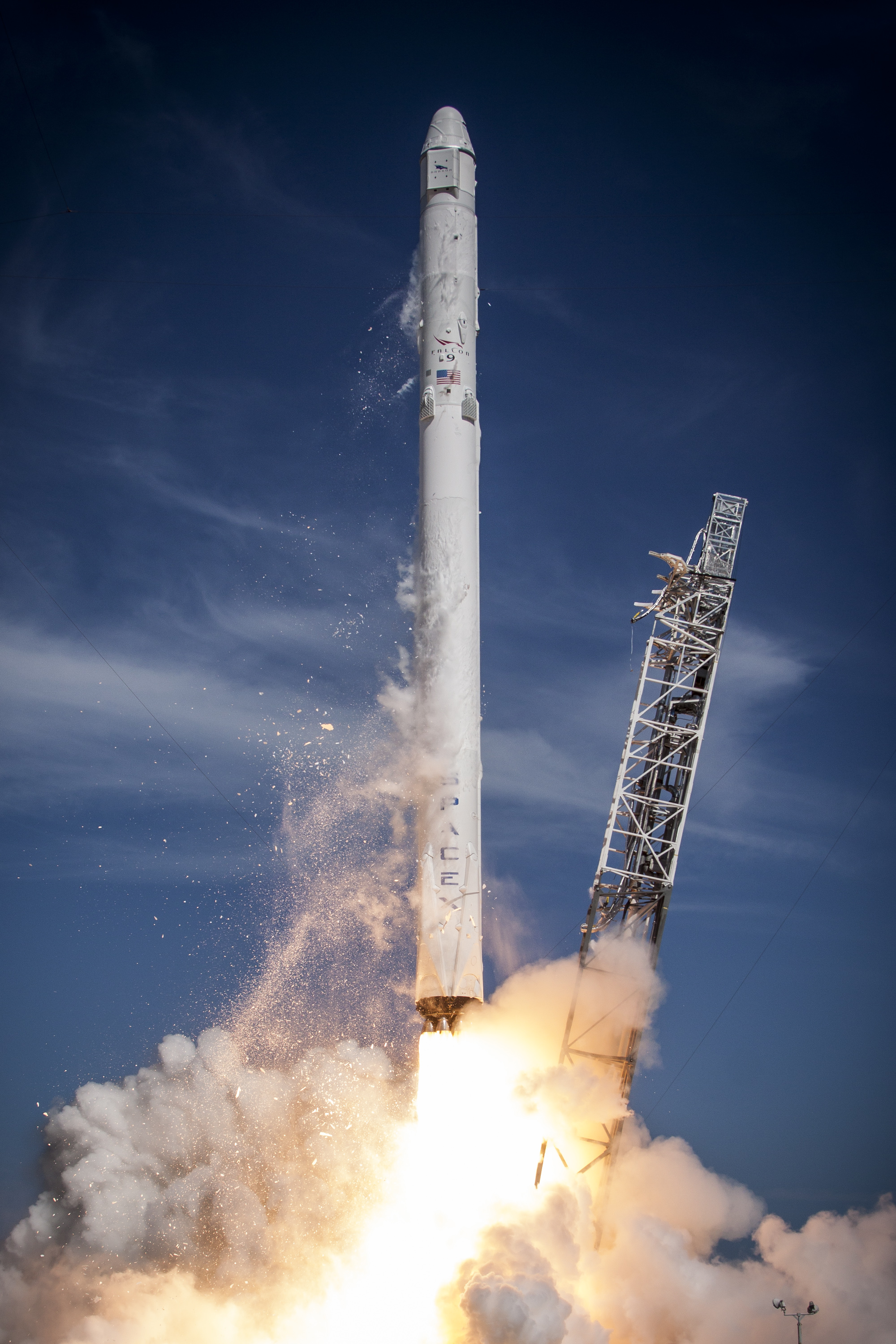
Falcon 9 Liftoff with Dragon Spacecraft
SpaceX Falcon 9 rocket ascending into low Earth orbit carrying the Dragon cargo spacecraft.
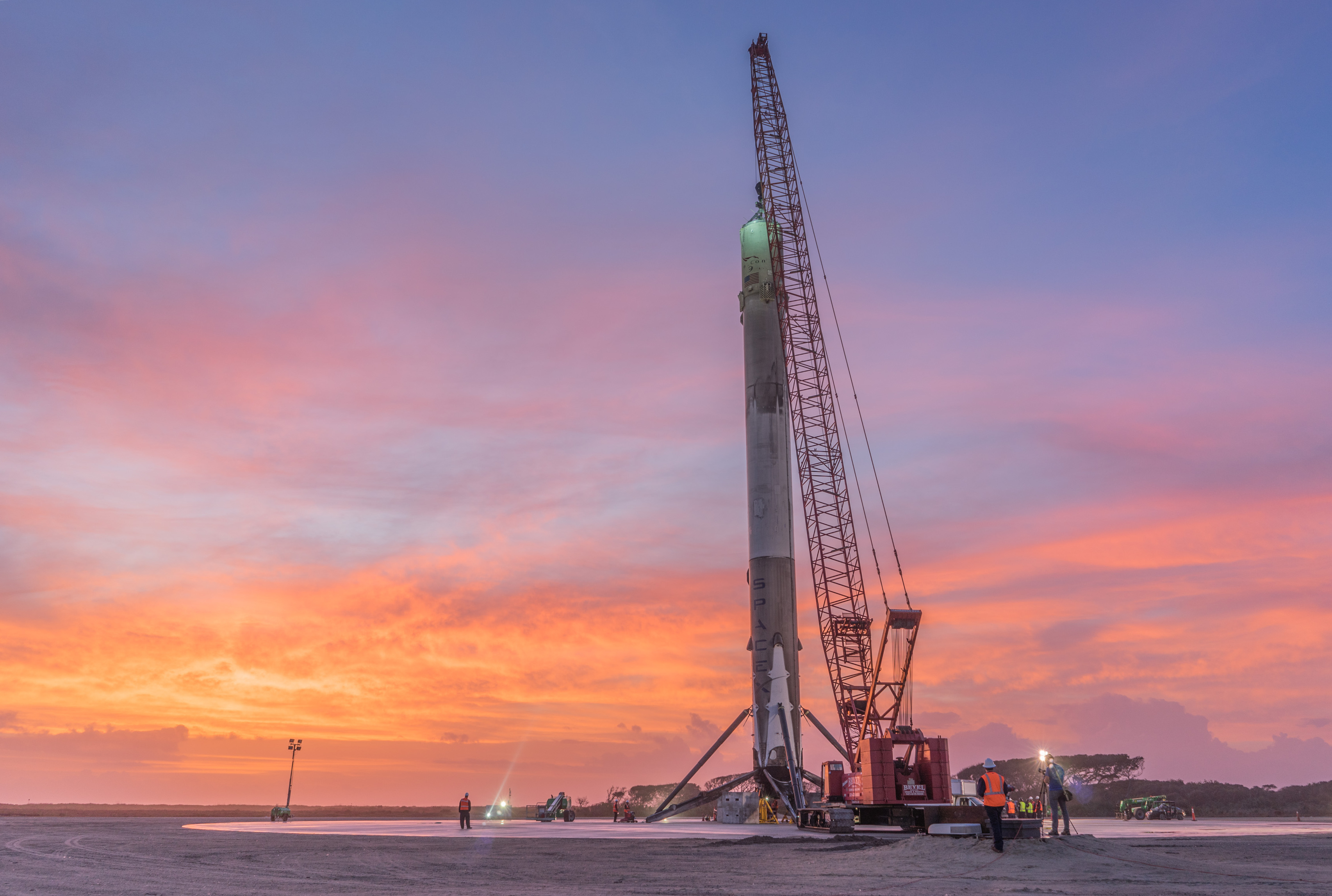
First Stage Landing at Landing Zone 1
Falcon 9 booster stage standing upright on the LZ-1 concrete pad following a historic Return-To-Launch-Site recovery.

Autonomous Spaceport Drone Ship Landing
Falcon 9 booster stage completing a precision vertical landing on the autonomous drone ship at sea.

Falcon 9 Transporter Erector Rollout
Falcon 9 rolling out horizontally to Space Launch Complex 40 at Cape Canaveral.

CRS-9 Night Launch & Exhaust Plume
Falcon 9 launching Dragon spacecraft to the International Space Station under the cover of night.
SpaceStats Launch Manifest & Database
15 mission records cataloged in database
| Flight / Mission | Orbit | Launch Date | Pad / Location | Booster / Landing | Status | Details |
|---|---|---|---|---|---|---|
Falcon 9 Block 5 | O3b mPower 11-13 O3b mPower 11-13 | MEO | Sep 30, 2026 | Space Launch Complex 40 Cape Canaveral SFS, FL, USA | Unknown F9 ASDS | TBD | Details → |
Falcon 9 Block 5 | SDA Tranche 1 Tracking Layer A SDA Tranche 1 Tracking Layer A | PO | Sep 30, 2026 | Space Launch Complex 4E Vandenberg SFB, CA, USA | B1080 ASDS | TBD | Details → |
Falcon 9 Block 5 | Crew-13 Crew-13 | LEO | Sep 12, 2026 | Space Launch Complex 40 Cape Canaveral SFS, FL, USA | B1101 ASDS | GO | Details → |
Falcon 9 Block 5 | Starlink Group 15-24 Starlink Group 15-24 | LEO | Sep 4, 2026 | Space Launch Complex 4E Vandenberg SFB, CA, USA | B1088 ASDS | GO | Details → |
Falcon 9 Block 5 | Starlink Group 15-23 Starlink Group 15-23 | LEO | Sep 1, 2026 | Space Launch Complex 4E Vandenberg SFB, CA, USA | B1063 ASDS | GO | Details → |
Falcon 9 Block 5 | Starlink Group 15-22 Starlink Group 15-22 | LEO | Aug 26, 2026 | Space Launch Complex 4E Vandenberg SFB, CA, USA | B1082 ASDS | GO | Details → |
Falcon 9 Block 5 | Starlink Group 10-49 Starlink Group 10-49 | LEO | Aug 25, 2026 | Space Launch Complex 40 Cape Canaveral SFS, FL, USA | B1067 ASDS | GO | Details → |
Falcon 9 Block 5 | Starlink Group 15-20 Starlink Group 15-20 | LEO | Aug 22, 2026 | Space Launch Complex 4E Vandenberg SFB, CA, USA | B1100 ASDS | GO | Details → |
Falcon 9 Block 5 | Starlink Group 10-39 Starlink Group 10-39 | LEO | Aug 20, 2026 | Space Launch Complex 40 Cape Canaveral SFS, FL, USA | B1078 ASDS | GO | Details → |
Falcon 9 Block 5 | Starlink Group 17-50 Starlink Group 17-50 | LEO | Aug 19, 2026 | Space Launch Complex 4E Vandenberg SFB, CA, USA | B1097 ASDS | GO | Details → |
Falcon 9 Block 5 | Globalstar 2-R Mission 1 (x 8) Globalstar 2-R Mission 1 (x 8) | LEO | Aug 16, 2026 | Space Launch Complex 40 Cape Canaveral SFS, FL, USA | B1090 ASDS | SUCCESS | Details → |
Falcon 9 Block 5 | USSF-366 USSF-366 | LEO | Aug 15, 2026 | Space Launch Complex 4E Vandenberg SFB, CA, USA | B1088 ASDS | SUCCESS | Details → |
Falcon 9 Block 5 | Starlink Group 17-49 Starlink Group 17-49 | LEO | Aug 12, 2026 | Space Launch Complex 4E Vandenberg SFB, CA, USA | B1103 ASDS | GO | Details → |
Falcon 9 Block 5 | Starlink Group 10-19 Starlink Group 10-19 | LEO | Aug 10, 2026 | Space Launch Complex 40 Cape Canaveral SFS, FL, USA | B1085 ASDS | GO | Details → |
Falcon 9 Block 5 | Starlink Group 17-38 Starlink Group 17-38 | LEO | Aug 8, 2026 | Space Launch Complex 4E Vandenberg SFB, CA, USA | B1093 ASDS | GO | Details → |