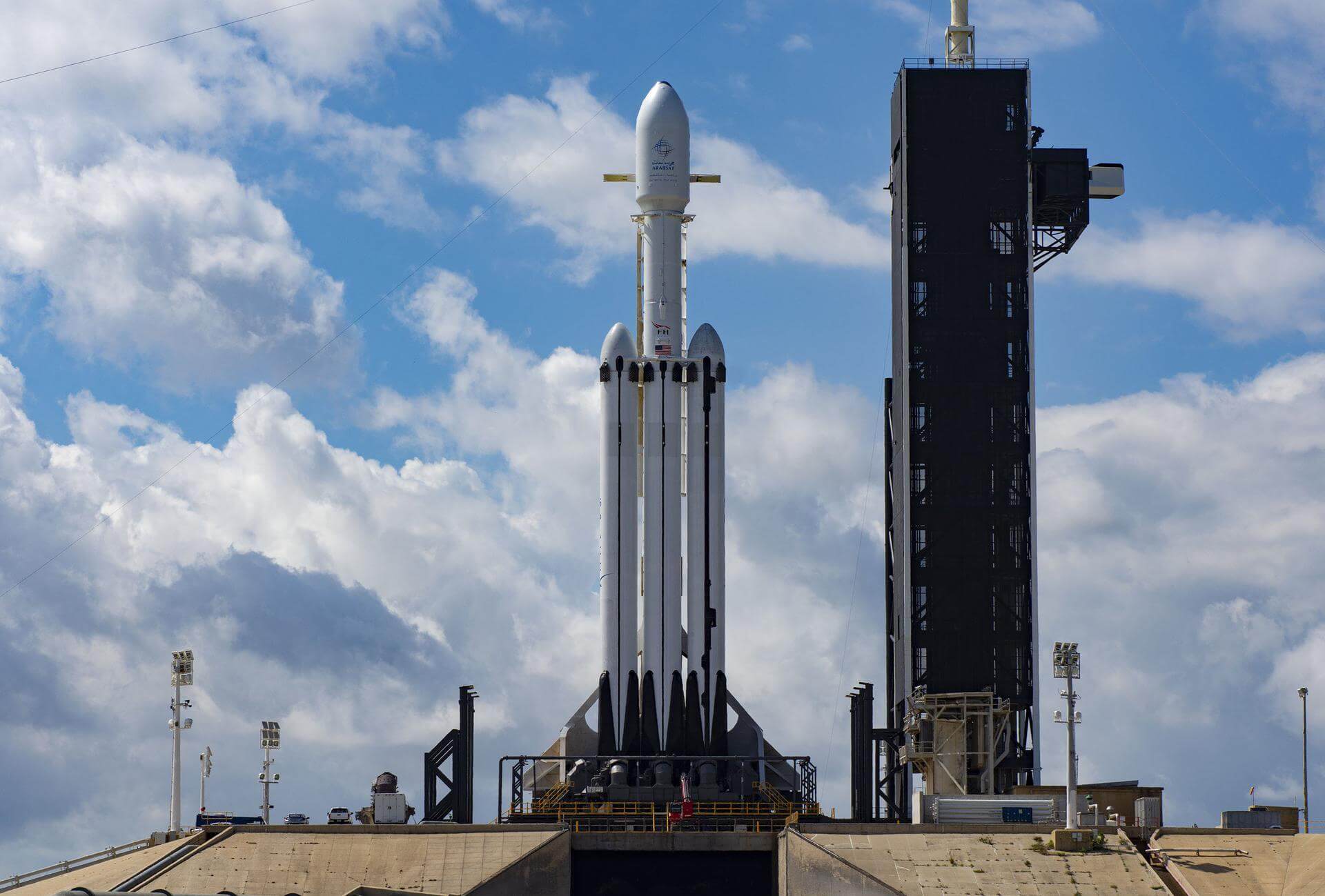
Falcon Heavy | Nancy Grace Roman Space Telescope
Pad: Launch Complex 39A · Kennedy Space Center, FL, USA
The Nancy Grace Roman Space Telescope is a NASA infrared space telescope with a 2.4 m (7.9 ft) wide field of view primary mirror and two scientific instruments. The Wide-Field Instrument (WFI) is a 300.8-megapixel multi-band visible and near-infrared camera, providing a sharpness of images comparable to that achieved by the Hubble Space Telescope over a 0.28 square degree field of view, 100 times larger than imaging cameras on the Hubble. The Coronagraphic Instrument (CGI) is a high-contrast, small field of view camera and spectrometer covering visible and near-infrared wavelengths using novel starlight-suppression technology. Roman objectives include a search for extra-solar planets using gravitational microlensing, and probing the expansion history of the Universe and the growth of cosmic structure, with the goal of measuring the effects of dark energy, the consistency of general relativity, and the curvature of spacetime.

Falcon Heavy Clearing Launch Tower 39A
Photo: NASA / Joel Kowsky
Falcon Heavy | Nancy Grace Roman Space Telescope Live Coverage
Official Webcast Feed Scheduled
Live broadcast embeds typically go live 15 to 20 minutes prior to launch window liftoff. Check the official SpaceX channels or Spaceflight Now for live feeds.
🛰️ Mission Orbital & Environment Matrix
- Target Orbit
- L2
- Target Altitude
- 550 km
- Inclination
- 53.2°
- Weather Violation Risk
- 10%
- Primary Payload
- Nancy Grace Roman Space Telescope
- Launch Window
- Sunday, August 30, 2026 at 11:26 AM UTC – 11:26 AM UTC
♻️ Hardware Reusability & Recovery Matrix
- Booster Core
- Unknown FH
- Flight Count
- Operational Flight
- Recovery Strategy
- ASDS
- Fairing Recovery
- Flight Proven
- Landing Vessel / Zone
- Designated Landing Zone
- Vehicle Architecture
- Falcon Heavy Technical Specs & Flight Geometry →
⏱️ Operational Timeline Milestones & Staging Sequence
Target T-0: 2026-08-30Terminal Count
T-00:15:00Autonomous launch sequence start
Auto Sequence
T-00:03:00Flight computer assumes control
Liftoff
T-00:00:00Stage 1 main engine ignition & liftoff
MECO & Stage Sep
T+00:02:40Main engine cut-off and stage separation
Stage 1 Landing
T+00:08:30Booster touchdown on recovery vessel / zone
Payload Deploy
T+00:45:00Spacecraft insertion into target orbit
Launch Complex 39A
Kennedy Space Center (NASA) · Kennedy Space Center, FL, USA

Historic Pad 39A Fixed Service Tower
Daylight view of Launch Complex 39A Fixed Service Structure equipped with the Crew Access Arm and Falcon 9 vertical on the launch mount.
Photo Credit: NASA / Joel KowskyThe world's most historic orbital pad, LC-39A hosted the Apollo 11 moon mission and the first Space Shuttle flight (STS-1). Leased by SpaceX in 2014, it supports crewed commercial flights to the ISS, Falcon Heavy heavy-lift launches, and future orbital missions.